
Read the full article at uregina.ca. Excerpt below:
At the University of Regina, researchers are laying the groundwork for the next generation of nuclear energy innovation. A large new facility is being prepared to house two test loops that will simulate the conditions inside a nuclear reactor, with the first expected to begin operating in early 2027 and a second, larger loop following in 2028.
The researchers who will use the test loops are already hard at work. Dr. Arthur Situm, assistant professor in Energy Systems Engineering and Tier 2 Canada Research Chair in Small Modular Reactor Safety and Licensing, often explains nuclear reactors with a straightforward analogy that anyone can follow.
“Fundamentally, what we’re doing is boiling water,” he says. “These things are essentially giant water boilers that we use to spin a turbine to power electricity.”
In other words, it’s a kettle on a stove, on a far larger scale.
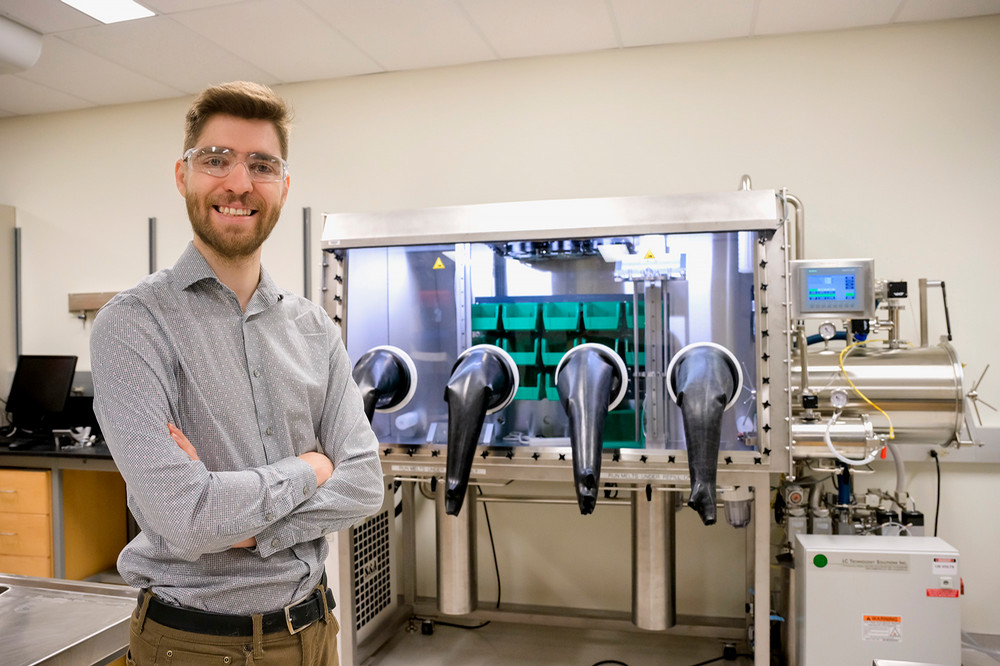
Situm’s research group in the Faculty of Engineering and Applied Science studies the safety of the fuels and materials used in small modular reactors (SMRs), advanced nuclear reactors designed to be built in modules. Their work will play a key role in the future Small Modular Reactor Safety, Licensing and Testing (SMR-SLT) Centre, where researchers will investigate the performance and safety of reactor components under realistic operating conditions.
The group’s work spans accident-resistant fuels, the long-term behaviour of new reactor fuels in underground storage, and corrosion in molten salts, a coolant used in some advanced reactor designs. Much of that research takes place in the University’s dedicated radiological laboratory, which Situm describes as a “kind of a hidden gem that the university has access to.”
The U of R’s Small Modular Reactor Safety, Licensing and Testing (SMR-SLT) Centre, announced in January 2026, will build on that foundation.
The centre and its two test loops will support both research and hands-on student learning. Although they replicate conditions found inside a nuclear reactor, neither uses uranium. Both are heated electrically, providing a safe and flexible environment for testing and experimentation.
The first loop, the Component Corrosion Test Loop, is expected to begin operating in early 2027. It will test whether materials and components, including valves and the metal tubes that hold nuclear fuel, can withstand reactor conditions.
The second, larger loop, known as the Natural Circulation Flow Loop, is expected to begin operating in 2028 and will demonstrate how a reactor can remove heat and remain cool through natural circulation, without relying on pumps.
Situm says its emergency cooling system looks “very similar to the radiators you might have in your home if you have old-style baseboard heating.”
For Situm, the value of the test loops is practical: understanding how a component or a cooling system will behave before it is ever placed inside a reactor.
Beyond advancing reactor safety and performance, this work supports Saskatchewan’s long-term energy strategy. In a provincial plan released in September 2026, the province set a goal of developing at least 2,600 megawatts of nuclear power capacity by 2050.